
Taiwan’s contemporary art scene is a vibrant fusion of deep-rooted tradition, political dynamism, and technological innovation. For global art lovers, defining the “Taiwanese aesthetic” can be elusive because it is constantly evolving.
From endurance performance art to digital net activism, and from traditional ink calligraphy to avant-garde printmaking, here are 10 essential figures who define the spirit of contemporary art in Taiwan.
1. Tehching Hsieh (謝德慶)
The Master of Endurance
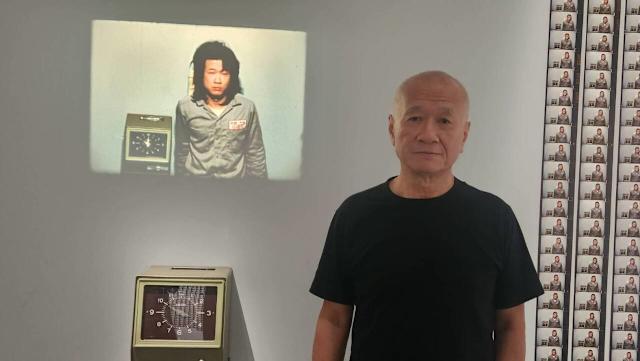
Tehching Hsieh is a monumental figure in the history of performance art, often cited alongside Marina Abramović for his extreme dedication to his craft. Between 1978 and 1986, Hsieh executed five distinct “One Year Performances” in New York City. These were not mere acts of theater but grueling tests of human existence and time. Whether locking himself in a cage for a year without speaking or reading, or punching a time clock every hour on the hour for 365 days, Hsieh used his own body and life as the primary medium. His work strips art down to the raw passage of time, questioning the very nature of being “productive” in a modern society.
- Why He Matters: Hsieh’s work is a masterclass in discipline and the philosophy of time. He fundamentally altered the global conversation on performance art, proving that the act of “living” itself can be the most profound artistic statement.
- Key Works:
- One Year Performance 1980–1981 (Time Clock Piece)
- One Year Performance 1978–1979 (Cage Piece)
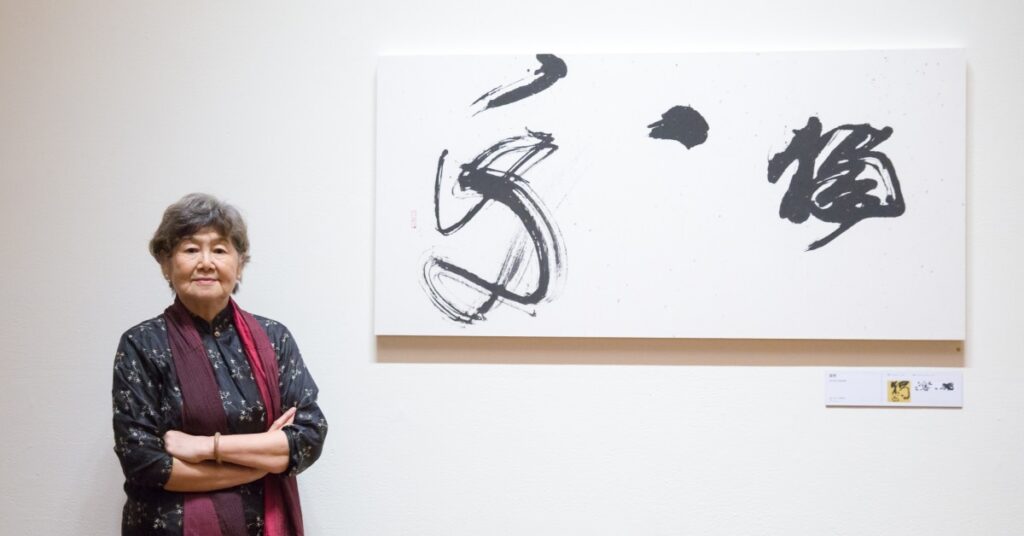
2. Tong Yang-Tze (董陽孜)
The Calligraphy Revolutionist
Tong Yang-Tze is arguably the most influential calligrapher in the Chinese-speaking world today. While deeply rooted in traditional discipline, she has single-handedly modernized the art form by liberating characters from the confines of standard paper. Her brushstrokes are monumental, often scaled up to architectural proportions that confront the viewer with their sheer physical energy and spatial presence. Beyond the gallery, she is a relentless cross-disciplinary experimenter, collaborating with jazz musicians, fashion designers, and digital artists to ensure that the ancient art of calligraphy remains a living, breathing language in the 21st century.
- Why She Matters: She successfully bridges the gap between ancient Eastern aesthetics and modern spatial design. Her work proves that traditional calligraphy can be abstract, grand, and avant-garde.
- Key Works:
- Immortal at the River (Monumental Cursive Script)
- Silent Music (Cross-disciplinary performance)
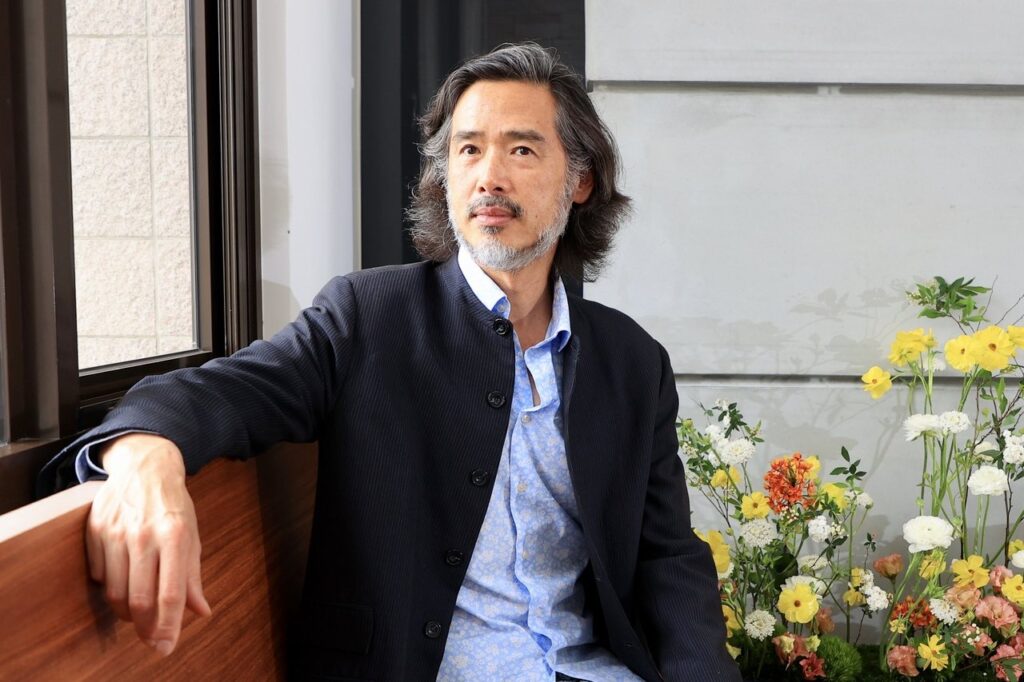
3. Lee Mingwei (李明維)
The Architect of Intimacy
Lee Mingwei’s practice focuses on “relational aesthetics,” where the artwork is not an object to be looked at, but an experience to be shared. His installations often function as carefully staged scenarios that invite strangers to engage in intimate, vulnerable interactions—such as mending a piece of clothing, sleeping in a museum, or writing a letter to an absent loved one. Lee creates a sanctuary within the institutional “white cube” of museums, turning cold spaces into sites of ritual, healing, and unexpected human connection. His work is quiet yet powerful, emphasizing the beauty of ephemeral moments between people.
- Why He Matters: In an increasingly digital and isolated world, Lee’s work offers a rare, tangible sense of human connection. He redefines the role of the artist from a creator of objects to a facilitator of relationships.
- Key Works:
- The Mending Project (Venice Biennale 2017)
- The Sleeping Project
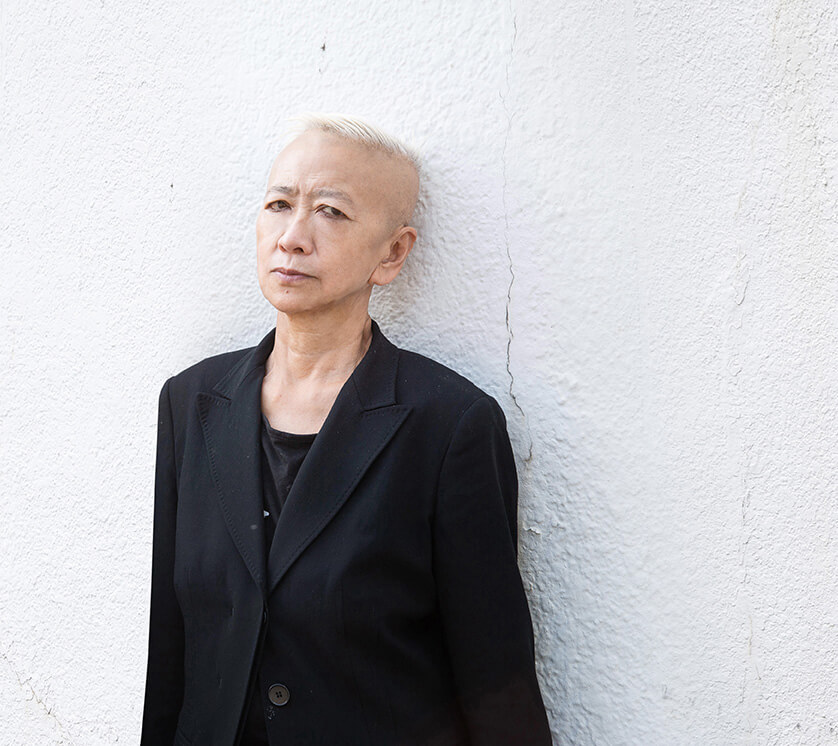
4. Shu Lea Cheang (鄭淑麗)
The Net Art Pioneer
A self-described “digital nomad,” Shu Lea Cheang was one of the first artists to recognize the internet as an artistic medium. Representing Taiwan at the 2019 Venice Biennale, her work is a radical exploration of sci-fi narratives, queer politics, and the surveillance state. She constructs complex digital and physical ecosystems—from hacking biometrics to imagining future societies run by viral networks. Her art is often chaotic, interactive, and deeply political, challenging the power structures that control our digital lives and bodies.
- Why She Matters: She is a visionary in “Net Art.” In 1998, she became the first internet artist officially commissioned by the Guggenheim Museum, solidifying her status as a pioneer in digital art history.
- Key Works:
- Brandon (Guggenheim Commission)
- 3x3x6 (Venice Biennale 2019)
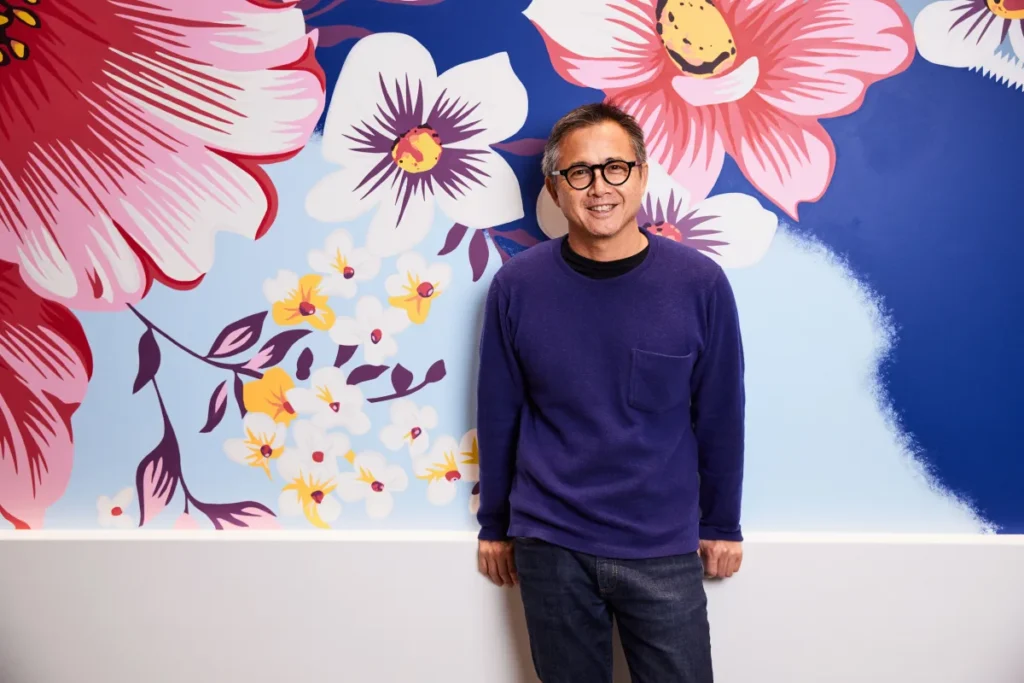
5. Michael Lin (林明弘)
The Pattern Strategist
Michael Lin is internationally renowned for transforming institutional architecture using traditional Taiwanese floral patterns. He takes the ubiquitous, brightly colored peony motifs found on Hakka textiles and domestic bedding in Taiwan, and magnifies them to colossal scales. By covering the floors, walls, and furniture of major museums with these patterns, Lin disrupts the serious, sterile atmosphere of the art world. His installations invite viewers to walk, sit, and lie down on the artwork, effectively turning a high-brow museum into a welcoming, communal living room.
- Why He Matters: Lin challenges the hierarchy between “high art” and “craft.” He successfully uses a hyper-local symbol (the Taiwanese floral cloth) to intervene in global architectural spaces.
- Key Works:
- Grind (PS1 Contemporary Art Center, NY)
- Model Home (Rockbund Art Museum)

6. Yao Jui-chung (姚瑞中)
The Cynical Observer
Yao Jui-chung serves as one of Taiwan’s most critical cultural observers. His practice is incredibly diverse, spanning photography, gold-leaf painting, and installation. He is perhaps best known for his biting political satire and his obsession with the absurdity of history. In his famous “Mirage” project, he mobilized his university students to document hundreds of “mosquito halls”—expensive public buildings in Taiwan that were built and then abandoned. This project was not just art; it was a form of social activism that forced the government to address waste and corruption.
- Why He Matters: Yao demonstrates how art can function as social accountability. His work is a perfect blend of dark humor, historical critique, and civic action.
- Key Works:
- Mirage: Disused Public Property in Taiwan
- Long Live series (Cynical Pop Art)
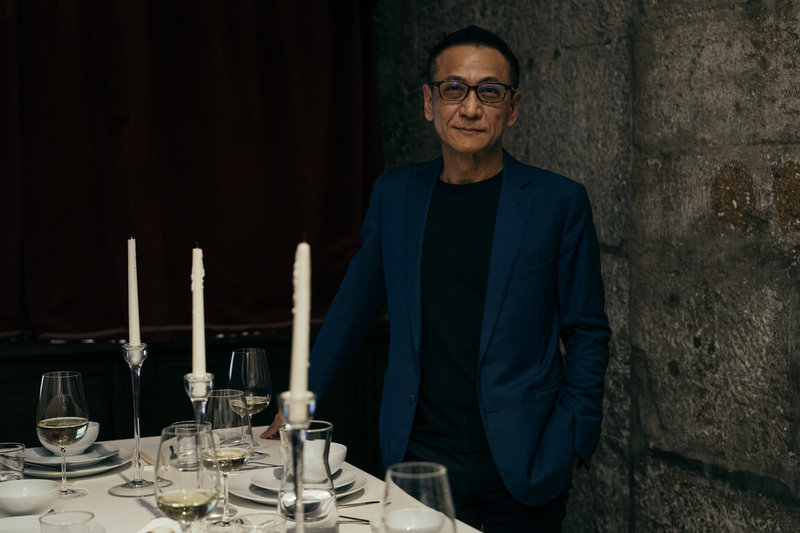
7. Yuan Goang-ming (袁廣鳴)
The Poet of Video Art
A pioneer of video art in Taiwan, Yuan Goang-ming uses digital technology to explore the uncanny nature of existence. He is a master of technical manipulation, using drones, cable cams, and composite scanning to create images that feel real yet impossible. His works often depict everyday scenes—a city street, a living room—but strips them of human presence or suspends them in an explosive state. This creates a haunting, poetic atmosphere that speaks to the anxiety, isolation, and precariousness of modern life in Taiwan.
- Why He Matters: Yuan pushes the technical boundaries of video art while maintaining a deep emotional resonance. His visual language captures the “unsettled” feeling of contemporary urban life.
- Key Works:
- City Disqualified
- Dwelling (Explosion series)
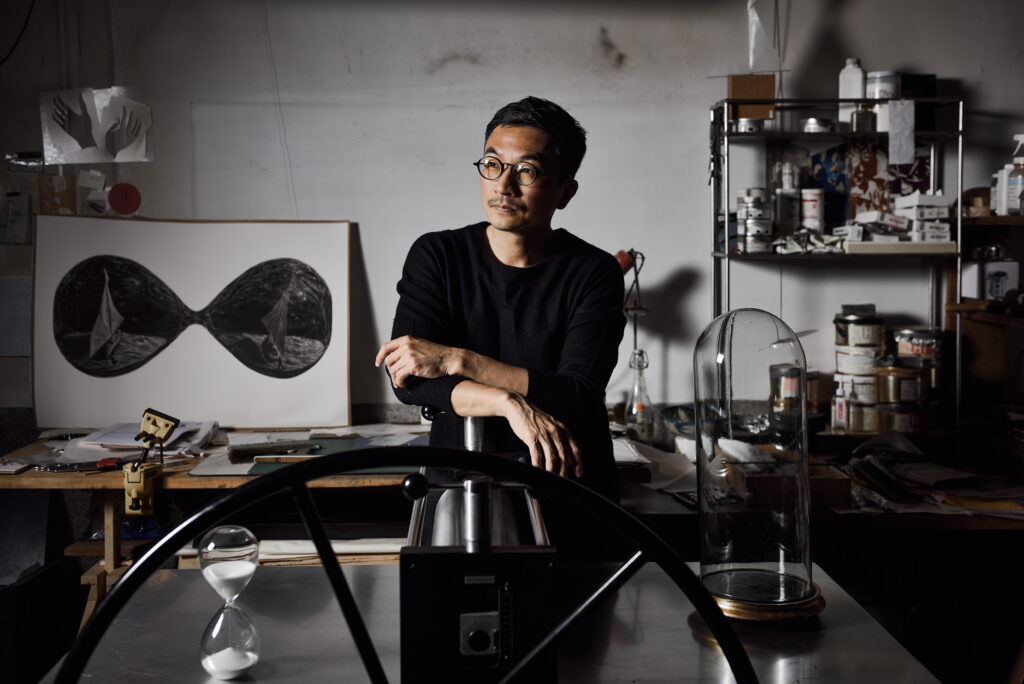
8. Yang Chung-ming (楊忠銘)
The Contemporary Printmaking Visionary
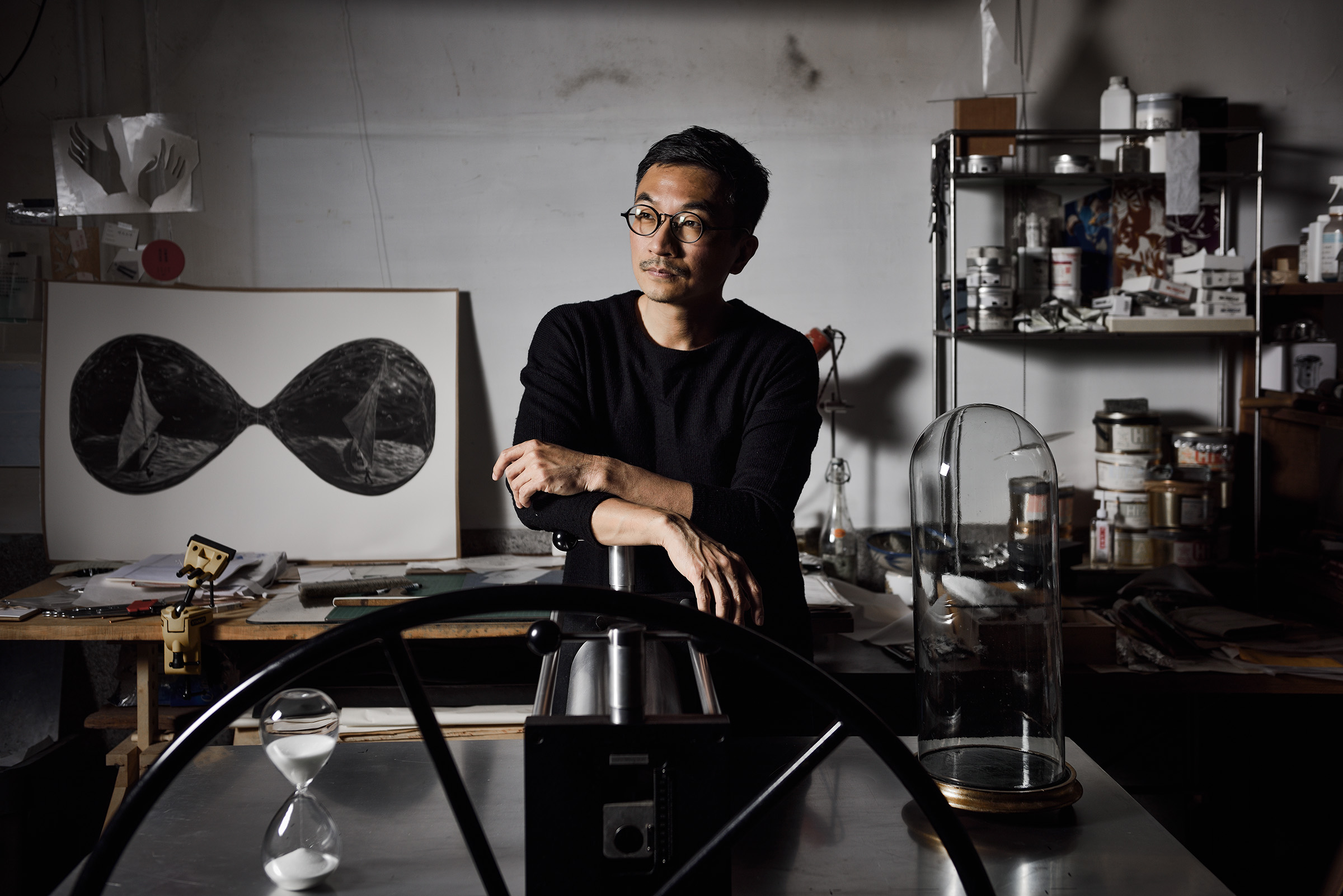
Yang Chung-ming is a unique figure who navigates the delicate boundary between historical artifact and modern creation. While printmaking is often seen as a traditional craft, Yang reinvents it as a conceptual medium to explore memory and time. His intricate wood engravings and lithographs are not just images; they are dialogues with the past. He holds a singular distinction in the art world: he is the only contemporary artist whose work has been collected by the National Palace Museum in Taipei. This acquisition symbolizes a rare bridge between the imperial collection of the past millennia and the artistic voice of modern Taiwan.
- Why He Matters: His inclusion in the National Palace Museum collection validates his role as the connector between Chinese art history and contemporary Taiwanese identity. He elevates printmaking from technique to philosophy.
- Key Works:
- Dream of the Red Chamber series (Collected by NPM)
- Reliable Landscapes
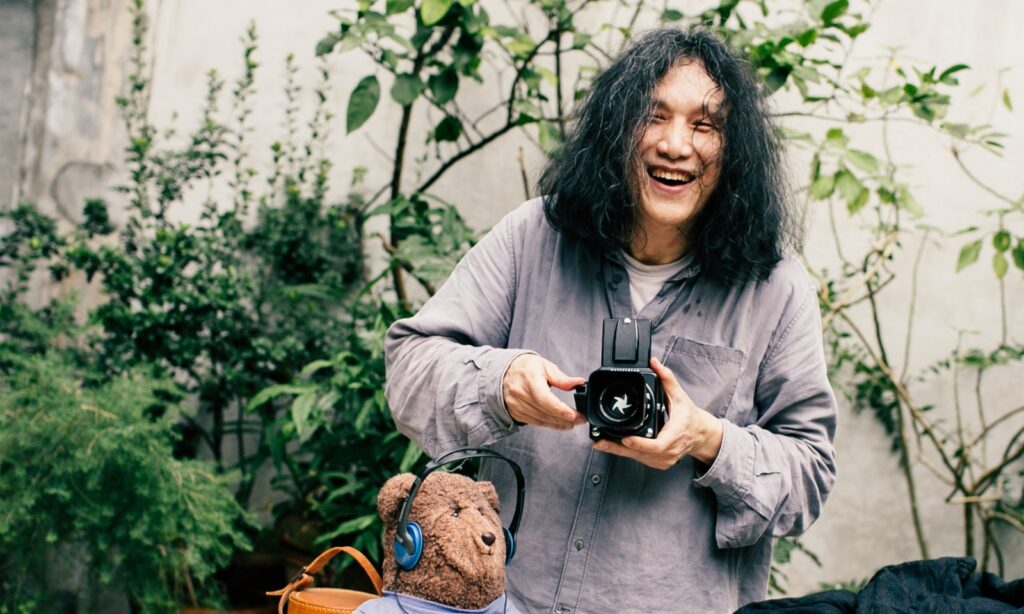
9. Quo Ying-sheng (郭英聲)
The Visual Solitudist
Quo Ying-sheng is a legendary photographer whose images are instantly recognizable for their deep sense of solitude and surrealism. Unlike the documentary style prevalent in his generation, Quo’s work is deeply internal and psychological. His photographs often feature isolated figures, barren landscapes, or fragmented memories, all bathed in a mood of poetic melancholy. Having spent years in Paris and Tokyo before returning to Taipei, his lens captures a cosmopolitan yet profoundly lonely perspective on the world.
- Why He Matters: He introduced a “mental landscape” approach to Taiwanese photography. His work is less about recording reality and more about projecting an inner state of mind.
- Key Works:
- Grass series
- The Echo
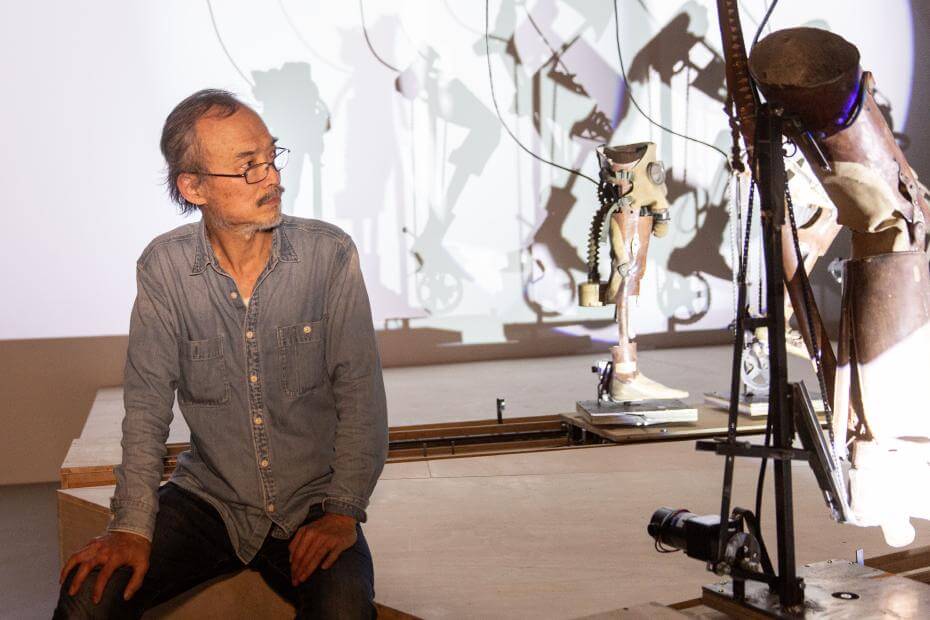
10. Kao Chung-Li (高重黎)
The Image Archaeologist
Kao Chung-Li works at the intersection of photography, sculpture, and media archaeology. He is fascinated by the machinery of vision—how cameras, projectors, and screens shape our understanding of history and truth. Kao often hand-builds his own projection devices and optical toys, using them to deconstruct historical images or political propaganda. His work is intellectually rigorous, challenging the viewer to stop passively consuming images and start understanding the “politics of seeing.”
- Why He Matters: Kao is a philosopher-artist who critiques the dominance of visual media. In an era of fake news and deepfakes, his deconstruction of the “image” is more relevant than ever.
- Key Works:
- Slideshow of a Palm-Sized History
- Photochemical Mechanical Mobile Images
Discover more curated collections and automated art insights at Exhibique.